jueves, 9 de mayo de 2013
Public International Law Q & A
1) Are individuals today subjects of International Law?
Altough States are the principal legal person within the international legal system, nowadays individuals are also subjects of International Law. A subject of the law is an entity capable of possessing international rights and duties and having the capacity to maintain its right by bringing international claims. Therefore, international legal personality may entitle a subject of international law to bring legal claims to enforce international legal rights, have the power to make interantional agreements, enjoy various immunities and privileges and be under certain interantional legal obligations.
The traditional position consider that States already act on behalf of their nationals, consequently, it was thought that individuals did not possess direct international legal rights and obligations. However the traditional position is no longer accurate.
Individuals have duties as a matter of international law. These obligations have been restricted to the criminal sphere. The notion of individual criminal responsibility was first applied by the International Military Tribunal at Nurember in 1946. The concept of individual criminal responsibiliity was developed and applied by the UN Security Council on an ad hoc basis when it estalished the International Criminal Tribunal for Rwanda and the International Criminal Tribunal for Yugoslavia.
Now it is accepted that individuals have rights at the elvel of itnernational law. However, these rights are dependent on particular States ahving fiven their consent to teh rights in question. So individuals may have indirect international legal rights. Further, wheter that right can be enforced depends on the institutional machinery and procedures wich accompany the right in question.
In certain regional systems, individuals have the right to make legal claims such as in the European COurt of Human Rights or in the Inter-American Court on Human Rights.

martes, 23 de abril de 2013
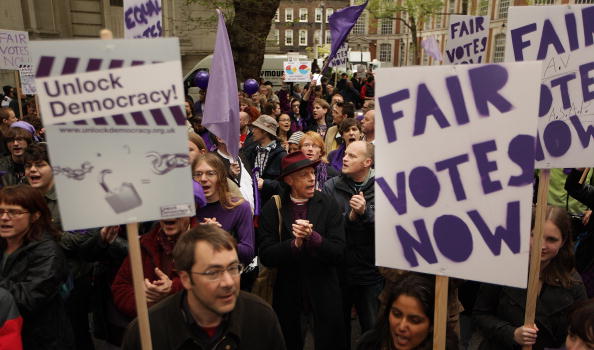
Reconceptualising Electoral Reform
Three ways of development in the study of electoral reform
- The systematic description and consequences of electoral systems
Majoritarian vs proportional
Outline of the consequences of the choice of either system for parties and party systems
Attributes beyond the electoral formula, district magnitude and ballot structure - The analysis of major reform and its political consequences
The relationships between electoral systems and other aspects of politics suc as governability, representation, accountability and participation
The result of representation systems were the cause of the results of multiparty systems
Impact of voting system choice and the handling of social conflicts
Research wheter proportional systems guaranteed inclusiveness and induced more consensus orientated politics, or were the result of the existing relationship between ethnic linguistic, religious and regional cleavages. When it comes to accountability , studies focused on whether majority systems were neccesary to assure it, or wheter proportional systems with low magnitude multi-member districts or mixed electoral systems preserved the relationship between the candidate and the voter - More comprehensive approach to the study of electoral reform
Assumptionthat once an electoral sytem is implemented it should be seen asset in stone, and that change is possible only when it is accompanied by ruptures in historical and political developments, or systematic transtion
Eastern European countries and their almsot constant reform
Two goals
- To shift attention away from the political consequences of electoral change and what takes place before the passage of reform
- Analyse the determinants of electoral reform. Elaborate an agenda for future research in electoral change, and they do so by discussing both the reconceptualisation and the methodology of electoral reform research. Look back at what underlies the study of electoral reform
Two categories on electoral systems literature
- Studies that treat electoral systems as an independent variable, as explanans
- Studies that view electoral systems as a dependent variable as the explanandum
What is Electoral Reform?
It is necessary adopt a more expansive view of electoral reform and a systematic approach toward conceptualizing different types of reform.
It is necessary adopt a more expansive view of electoral reform and a systematic approach toward conceptualizing different types of reform.
It should be study other attributes affection involving electoral systems, and the changes in these arrangements. Include the study of minor reforms: changes in intra-party processes such as candidate selection procedures and or changes in party finance structures. Any change in the electoral rules that leads to a change in the operation of the electoral system.
Why does Electoral Reform occur?
Dominant rational choice theory: electoral reform is due to the strategic calculations of elites who choose electoral rules that suit their own ends of maximizing gains and/or missing losses. It is necessary moving away from a single primary motivation, or a single approach toward a more comprehensive framework for analysis based on a synthesis of determinants
In the era world, there will be a high level of uncertainty in terms of its effects, since reforms affect several dimensions of political life. Other aspects that adds to the uncertainty and makes both politicians and reluctant to change is the impact that the act of reform and the act itself. Other theoretical approaches, such as behaviouralist institutionalist are useful in analyzing the determinants of electoral reform. It is also not taken account, the relevance of diffusion and contagion as a possible source of electoral reform. The institutionalist approach is also often used to explain non reform,or when proposed reforms are vetoed. The veto player theory foe electoral reform focuses on the procedures to adapt constitutions or to change electoral legislation.
Who indicates electoral reform?
Increasing awareness of other actors and or sources as initiators of or catalyst for reform, such as public opinion, pressure groups, the courts and referenda. Politicians and parties are not the only initiators of reform. Voters, pressure groups, courts, citizens' assemblies and experts can be as well. The use of single case studies is one of the consequences of restricting the object of study to major reforms, since this kind of reform does not occur often, and only in a few countries. If one takes a more expansive view of electoral reform that includes changes inc certain aspects of the electoral system then many more cases can be found. Nevertheless quantitative studies remain the exception rather than the rule in the field of electoral reform.
Where does electoral reform happen?
The study of electoral reform can be advanced by the inclusion of countries other than established democracies. It is necessary to expand our academic analysis to cover the persistent electoral reforms outside the established democracies, in order to build better concepts and theories.
Reconceptualising Electoral Reform
Shifting towards a combination of qualitative and quantitative approach, based on cross national survey data.
We need to reassess what electoral reform encompasses. At the very least research should move past major reform and beyond the national level. Adopt a more comprehensive definition Such a definition would give us the advantage of more diversity in terms of the type of research. Changing the unit of analysis may lead to a different understanding of the reform processes, but it will also certainly affect the number of cases to be studied and consequently the methodology adopted.
Methodology
Future researchers of electoral reform should be more open in their methodological approach. If we wish to learn from both Newton and Heraclitus, we will perceive stability and change as the two sides of any political institution. Only then will we learn not only which determinants serve as catalysts for reform, but also what the conditions for maintaining stability are.
Future researchers of electoral reform should be more open in their methodological approach. If we wish to learn from both Newton and Heraclitus, we will perceive stability and change as the two sides of any political institution. Only then will we learn not only which determinants serve as catalysts for reform, but also what the conditions for maintaining stability are.
Reconceptualising Electoral Reform
Monique Leyenaar and Reuven Y.Hazan
West European Politics,
Vol. 34, No. 3, 437-455. May 2011
.
lunes, 22 de abril de 2013
Presidentialism, Multipartism, and Democracy: The Difficult Combination
The combination of a multiparty system and presidentialism is especially inimical to stable democracy.
Multiparty presidentialism is especially likely to produce immobilizing executive/legislative deadlock, and such deadlock can destabilize democracy.
Multipartism is more likely than bipartism to produce ideological polorization, thereby complicating problems often associated with presidentialism. The combination of presidentialism and multipartism is complicated by the difficulties of interpaty coalition building in presidential democracies, with deleterious consequences for democratic stability.
The choice regarding institutions are important, none is more important than the system of government.
Subcategory of presidential systems: those in multiparty democracies
Weakness: the rigidity associated with the fixed tem, executive/legislative deadlock, and a greater likelihood that the head of government will have limited administrative and party experience. It do not have mechanism intended to ensure legislative majorities (the president's party often has majority, or close to it, in two-party system, but rarely does so with multipartism).
There are just 4 democracies between 31 stable democracies with this institutional configuration.
Multiparty presidentialism is more likely to produce immobilizing executive/legislative deadlock than either parliamentary systems or two party presidentialism.
Two-party systems presidentialism is more likely. High -entry barriers keep radical actors out of the party system, and the need to win votes from the center encourages moderation, and the abscence of extremist parties and the centripetal nature of party competition favoring democratic stability by assuring actors that electoral and policy losses will not have catastrophic consequences.
Presidentialism and multipartism is complicated. Difficulties of interparty-coalition building in presidential democracies.
Multiparty coalitions in parliamentary system, the parties choose the cabinet and prime ministers, and they remain responsible for providing support for the government. In presidential systems, presidents put together their own cabinets, and the parties are less firmly committed to supporting the government. In presidential systems legislators of parties with cabinet portfolios do not support the government. Incentives for parties to break coalitions are generally stronger in presidential systems.
Democracy criteria
- Democracies must have open competitive elections that determine who governs.
- Election results cannot be determined by fraud, coercion or major proscriptions.
- Legislative and executive office must be decided on the basis of elections.
- Elections must be afford the opportunity of alternation in power.
- Universal adult suffrage.
- Guarantees of traditional civil liberties.
Presidential democracy (The chief executive is elected by the legislature and term office is fixed)
- The head of government is essentially popularly elected.
- Legislative elections and post-election negotiations do not determine executive power.
- The Head of government is selected by the legislature.
- President must be the head of government (except semi-presidential systems).
- The president is elected for a fixed time of period (president can not be forced to resign because of a no-confidence vote).
Parliamentary democracy
- Executive branch exists separately from the legislature.
- No post-election negotiations.
- Fixed term for head of government
- The head of government is selected by the legislature and subsequently depends upon the ongoing confidence of the legislature for remaining in office.
Presidentialism and stable democracy
Democratic longevity. Most of the unstable democracies since 1945 are presidential systems or parliamentary multiparty systems.
Parliamentary systems have mechanism that may lead to relatively frequent changes in cabinets and governments, but this flexibility in changing governments may help preserve regime stability. On the hooter hand, the fixed electoral timetable of presidential regimes apparently ensures stability in the head of government but introduces a rigidity inimical to regime stability. We need to distinguish between cabinet stability and regime stability. The fixed term also force the president to leave the charge even if the general population, political elites and parties, and other major actors continue to support them.
A greater likelihood of executive legislative deadlock. Presidential systems are more prone to immobility than parliamentary systems. They are more apt have executives whose program is consistently blocked by the legislature, and they are less capable of dealing this problem.
The downside of direct popular elections is that political outsiders with little experience in handling congress can get elected.
Presidentialism, multipartism, and stable democracy
Of the 31 presidential democracies, 15 had multiparty systems, 10 two-party systems, 5 dominant-party systems, and 1 two-and-one-half party system. Only 1 of the 15 multiparty presidential demcoraciesendured for at least 25 years.
Remember two-party system use to constrict the breadth of opinion represented, and hinder the building of coalition governments, making it difficult to establish consolidation forms of democracy. Two-party systems become less functional and less viable as the spread of opinion becomes greater.
In presidential systems, multipartism increases the likelihood of executive/legislative deadlock and immbobilism. It also increase the likelihood of ideological polarization. Multipartism, presidents need to build interpaty coalitions to get measures through the legislature, but interpaty coalition building in presidential systems is more difficult and less stable than in pariamentary systems.
Because of the separation of powers presidential systems lack means of ensuring that the president will enjoy the support of a majority in congress. Presidents can govern without a majority. Legislatures can block presidential action. In most presidential democracies, the president is largely responsible for policy and legislation. The role is marked by ambivalence and ambiguity.
Most presidential systems presidential role is marked by ambivalence and ambiguity. They can not implement their agenda, if their legislative don't support it.
Exceptions
- President's party enjoys a majority in the legislature and regularly backs the president.
- Coalition of parties provides a majority and regularly supports the president.
- President does not enjoy a stable majority in congress, but is able to govern by creating shifting coalitions.
Parliamentary systems are generally better providing stable support for governments and handle lack of legislative support.
In Presidential systems there is a dissociation between party affiliations of cabinet members and party coalitions.
In Presidential systems there is a dissociation between party affiliations of cabinet members and party coalitions.
The true minority parliamentary governments lasted an average of only 14 months. Presidential governments in which executive/legislative deadlock arises. The parliamentary mechanism of a no-confidence vote is not available. President lack tools for pushing policy through during period of executive/legislative deadlock.
If their congressional support dissipates, president become a sitting duck. Presidents use to try constitutional amends.
Immobilism in presidential democracies has often been a major ingredient in coups. Presidents got enormous responsibilities, they need administer huge, complex, state bureaucracies.
Presidentialism, multipartism and ideological polarization
Two or two and one half party systems are more likely to be compatible with presidential democracy because ideological polarization is unlikely. These systems have drawbacks, but they are based on the democratic theory of willingness of political actors to accept electoral and policy defeats. (Intense ideological divisions increase the stakes of the political game, serve as an incentive to polarization and consequently, are less favorable to stable democracy.
- Party support for the government tends to be more secure in parliamentary systems because of the way executive power is formed and dissolved. In presidential systems the president has the responsibility of putting together a cabinet. Change in cabinets are usually the president's decision and are not brought about by party decisions.
- In parliamentary systems, party coalitions generally take place after the election and are binding in presidential systems. In presidential systems, they often take place before the election and are not binding passt election day. Executive power is nor formed through post-election agreements among parties and is not derived among several parties that are coresponsible for governing. In Parliamentary systems, the same coalition formed government is responsible to govern. An agreement among parties may pertain only to congressional matters, with no binging implication for relations between the parties and the president.
- In presidential systems, the commitment of individual legislators to support an agreement negotiated by the party leadership is often less secure. There is a lack of party discipline.
- Incentives for parties to break coalitions are stronger in providentially system. As new presidential elctions appear on the horizon, party leaders generally feel a need to distance themselves from the president in office.
Conclusion
Combination of presidential government and multiparty system is problematic. It is not accident that most stable presidential democracies have had limited party system fragmentation. It raises the possibility that the liabilities of presidentialism pertain mostly to situations of multipartism. Multipartism acerbate some conflicts.
On the other hand, this doesn't happen with parliamentary regimes that have more coalition building mechanism that facilitate multiparty democracy.
Institutional combination facilitate and others obstruct the management of social, economic, and political problems.
In most presidential democracies legislative elections are based on proportional representation with district magnitudes sufficiently large to facilitate representation of several parties, making more like that the opposition control a solid majority in congress.
What can be done in terms of constitutional/institutional reform in multiparty presidential democracies?
- Switching from a presidential system to a semi presidential or a parliamentary system.
- Taking measures to reduce party system fragmentation. Limiting party system fragmentation, introducing a higher threshold reducing district magnitude in proportional system, having concurrent congressional and presidential elections.
Efforts to restructure a multiparty system into two-partism would adversely affect legitimacy, especially in party systems with significant ethnic, regional or religious parties that would dissapear under different electoral rules or a wide ideological distance. The advantages of bipartism thus diminish where there are sharp social or political cleaves.
A change to parliamentary government would need to simultaneously establish mechanism to enhance party discipline.

Presidentialism, Multipartism, and Democracy: The Difficult Combination
Scott MainwaringComparative Political Studies 1993 26: 198
domingo, 21 de abril de 2013
The Quantity and the Quality of Party System
Introduction
Research typically counts the quantity of parties (many research examines the merits of a two-party system vs a multiparty system and links the number of parties to the representation of social cleavages in voting behavior, turnout in elections, representation, and levels of poltiical conflict) . The more property is the quality of party competition - the polarization of political parties within a party system.
Why polarization is important to study?
A new measurement of party system polarization based on voter perceptions of party positions in the Comparative Study of ELectoral Sytems.
Comparation of party polarization and party fractionalization as influences on cleavage-based and ideological voting asn as predictors of turnout levels.
Instead of counting the quantity of parties, a moreimportant property is the quality of party system.
Party System polarization reflexts the degree of ideological differentiation among political parties in a system. The polarization of a party system is a property that can be independent of the number of parties. Party system polarization has strong effects than party fractionalization.
The Literature on Party Polarization
Downs: concept of the spatial modeling of party systems, in which political parties and voters are aligned along a Left and Right continuum. Framework for party competition. Two party system would converge to the center, multiparty systems would be spread along the dimension. Voters in multiparty systems are given a wide range of ideological choice. Regarding ideologies is more rational in multiparty system.
Sartori: high levels of party system polarization can intensify ideological debates, weaken the legitimacy of the regime and destabilize the political system.
The spatial models converge on a common framework for studing party systems.
Measuring Party System Characteristics
Two different methods to count the number of parties to give weight to the relative size of parties and not jsut their absolute numbers: party fractionalization (satistics), and the perceptions of the electorate in the nation. (questionnaire).
This last method implies consider the Left and Right scale (ask people where they situate themselves in the scale and where they stituate the main parties).
Party systems with a large number of parties also tend to be more polarized. The polarizzation of a party system reflects the dispersion of citizens along the ideological dimension.
Party polarization often reflects the itnernal dynamics of electoral competition in a nation. Parties and their leaders make strategic or ideological choices when they begin a campaign, and other parties respond to these choices.
The Correlates of Polarization
Polarization has important consequences. A highly polarized system presumably produces clearer party choices, stimulates participation, affects representation, and has more intense partisan competition. The ideological gap between winners and losers is greater and the policy implications of government control are more substantial. A centrist party system should reflect greater consensus within the electoral process and less interparty conflict and less political responsiveness.
The Polarization of Voter Preferences
If parties offer limited chocies to voters, then it is not likely tha t the voters blocs will differ sharply across parties. ''Voters in multiparty systems are more likely to be swayed by doctrinal considerations than are voters in two party systems''. (Use of surveys) - more ideological diversity of choice more clearly voters translate their Left-Right orientations.
The Party System and Voting Turnout
With few choices, voters have limtied opportunities to find a party that represents their views and thus may choose to abstain from voting. However as the number of chocies icnreases voters sould more easily find a party they agree with which justifies the effort to cast a ballot.
The nature of the choises available to voters is strongly related to the level of turnout in elections. The number of parties is less important than the diversity of chocies that the parties offer.
Polarization and Democratic Politics
Counting the number of parties is often a surogate for a richer characteristic of a party system that is more difficult to measure.
Polarization and fractionalization can vary almost independently of one another. (Public eprcetions of party positions).
Clear empirical differences in the correlates of polarization and fractionalization. The polarization of a party system is related to stronger correlations between class and the Left-Right relationship with party preferences. To the extent that poltiical parties are supposed to be channels of expression that allow citizens to vote their preferences, then party system polarization substantially strenghens this process- but party fractionalization has little impact on these relationships. Voting turnout appears more strongly related to party system polarization than fracitonalization.
Quality should count more than quantity

The Quantity and the Quality of Party Systems: Pary System Polarization, Its Measurement, and Its Consequences
Russell J. Dalton
Comparative Political Studies 2008 41:899
sábado, 20 de abril de 2013
Cartel Parties in Western Europe?
Introduction
Three analytical dimensions of the cartel thesis:
- Organizational change
- Functional change
- Change of party competition.
Western European parties have increasingly lost their capacity and their eagerness to fulfil their representative functions in society, whereas they have become more strongly involved in executing governmental functions. Professional party leaders are more concerned with policy making in the parliamentary arena than with interpreting party manifestos or discussing politics at party congresses. New source of financing and staffind their organizations. Weak involvement of party members and historically related interest groups in party activities on the one hand, and by emphasis on governmental functions and state resources on the other.
The organizational dimension
1. Balance of power inside the parties. The mechanics of internal decision-making are determined by the structural and material resources of the various faces within the organization. Cartel parties are characterized by the ascendancy of the party in public office: public office-holders dominate party executive organs and internal decision-making procedures. Party activists have only marginal influence, and election campaigns are organized by professional experts.
2. Vertical stratarchy of different party levels. Whereas the national party elite tries to free itself from the demands of regional and local party leaders as far as political and strategic questions on the national level are concerned, the lower strata insist on autonomy in their own domains, for example the selection of candidates or local politics.
Proffesional party leaders are more concerned with policy-making in the parliamentary area. Parties open up a new source for financing and staffing their organizations.
Turning to the level of party competition, the mutually shared need for securing the flow of state resources has changed the relationship of the political opponents towards each other. The party actors have realized that there are common interests among the political class. The process of cartel formation has two facets:
1.Cartelization aims at reducing the consquences of electoral competition (granting the opposition parties a certain share of state subventions) or patronage appointments).
2. Exclusion aims at securing the position of the established parties against newly mobilized challengers. The co-optation of new aprties that are willing to play according to the established rules can strengthen the viability of a party cartel
Weak involvement of party members and historically related itnerest groups governmental functions and state recourses on the other
Katz and Mair: the formation of these partys poses a fundamental problem for Western European party democracies, it denies voters the possibility of choosing a real political alternative and gives ammunition to the rhetoric of neo-populist parties on the political right. (Deslegitimize political decisions). Cartelization will widen the gulf between voters and politicians and make it increasingly difficult to legitimize political decisions.
Increased vulnerability causes party change. Vulnerability brought about a declining capacity of parties to fulfil their representative functions which subsequently led them to ceoncentrate on their governmental functions and to collude with their estbalished opponents in order to secure the requires resources for organizational sustenance. The freedom of manoeuvre which party leaders needed to do both led to itnernal party reforms. The links between the professionalized party organizations and the citizenry further eroded, which in turn instensified the trend towards the sphere of the state and to inter-party collusion.
Germany
Subsidies to the Parliamentary parties for employing research assistants and secretaries (s. 1959)
Individual MPs are able to claim an allowance for employing personal assistants (s.1969)
The party organizations receive state subventions for general political activities (1959-1966)
Campaign reimbursements and substantial subsidies for their political foundations (s.1967)
The introduction and expansion of public subsidies coincided with a massive expansion of the membership organizations and with a process of defragmentation in the party system in the 1960-1970.
Denmark
Subsidies to the parliamentary parties (s.1965), expanded in 1980.
Public subsidies to the party organizations (s.1986), quadrupled in 1995.
United Kingdom
There is no direct public subsidies to party organizations. Only modest payments to the parliamentary parties.
British parties are in control of the political decision-making process.
The Westminster system gives strong leeway to the governmental party in terms of political competence and patronage potential. The major parties choose to rely on non-state sources of finance.
Instead of mutually securing their respective organizational maintenance as envisaged i the cartel party model, the Conservative government violated vital interests of their opponents, while the Labour Party ended the implicit consensus on the institutional rules of the game.
Agreement on common organizational interests is a sine qua non for forming a party cartel.
Switzerland
Widespread consensus among the established parties about state funding.
Reformincluding better infrastructure for MPs was rejected in a referendum in 1992 showing the reclutance of Swiss citizens to accept the professionalization of politics.
The Swiss institutional setting, with federalism, direct democracy and corporatism represent alternative political channels to the parliamentary arena.
The three dimensions
- The Organizational Dimension
Ideal-type cartel parties are characterized by the ascendancy of the party in public office and by stratarchy.
National parliamentarians and cabinet members control the most important power positions within their party organizations at the national level.
There is autonomy between the different territorial party strata.
Regional party leaders lack influence on national party politics.
Federalization rather than stratarchy characterizes the internal power distribution of the parties.
In all parties, public office-holders constitute the majority within national executive commites (no the Labour Party, trade unions).
The leading party bodies have developed into multi.-level organs, bringing together the most important politicans of the national and subnational levels and representatives of the European level.
Party-specific features, such as electoral fortunes or the traditions of specific party families, are more important than cartel tendencies.
UK
The national executive still be dominated by national MPs and representatives of the corporate organizations. Only since the NEC reform in 1998, there been representation of public office-holders from different poltiical levels.
Trade unions got about 40% NEC representation.
New policiy-making bodies introduced in the 1990s, such as the 'Joing Policy Committee' or the 'National Policy Forum' are clearly dominated by the parliamentary leadership and ahave taken over competences once exercised by the NEC.
Reforms of the voting procedures at party conferences and the introduction of party plebiscities in the selection of candidates and party leaders reduced the political influence of trade union officials and party activists.
Labours are still be characterized by the rowking of party commissions bringing together all sections and wings of the party.
The delegates at party conferences still have veto rights, direct democratic procedures.
Programatic debates tend to be slow and driven by the search of compromises.
Until 1998, it was up to the parliamentary party leader of the British Conservatives to decide party policies. Only after the 1997 electoral fiasco the Conservatives decide to end the seapration of parliamentary and extra-parliametnary party and to give their memebers a say in the election of the party leader and to create and executive committe with formal policy-making competences. - The Functional Dimension
The ways the cartel parties fulfil their political role distinguish them from former party types. While parties increasingly lose their embeddedness in society, they compensateby making use of state resources and by focusing on their functions in parliament and government.
The Labour Party has traditionally been financed primarily by the affiliation fees of trade unions. Blair leadership successfully undertook efforts to reduce this financial dependence and to expand the party budget by reversing the downward trend of individual party memebership, raising membership fees and attracting donations from the business sector.
More budget = expand and professionalize party headquarters, and to employ new strategies of political marketing and capital-intensive campaigning. It also help to increase political autonomy.
However, the historical alliance with the trade unions continues to matter.
The Conservative Party has always been financed by donations from the business sector.
The Party did not develop permanent organizational linkages to business interests grups.
The leadership has always been less constrained by direct involvement of party members and interest groups than other party elites. It depends on financial and organizational resources provided by its supporters. - The Competitive Dimension
The systemic level of party competition. Party cartels are characterized by the cartelization of privileges and the exclusion of new parties. There is a high level of at least implicit interparty cooperation in securing state recources for themselves and building protective walls against new competitors.
In the UK, the majoritarian voting system, the unitary state structure and the absence of public funding made it quite difficult for third parties, especially on a national platform, to break the duopoly of Labour and Conservative.
-State funding is more likely to help rather than hinder new challengers to consolidate.
Other factors such as the voting system , the cleavages, orthe nature of coalition building have to be taken into account.
-There is no direct relationship between cartel formation and party system fractionalization.
- Alternative paths to a party cartel. We should allow for multiple causation when explaining cartel tendencies.
- We restrict the cartel thesis to its core elements.
- Instituional parameter proveded to be important: the electoral system reinforced (Denmark) or blocked (UK), the perception of vulnerability and thereby influenced the itnesity of pressure to adapt.
The strenght of the partys tate (Germany) furthered the capacities of parties to control their organizational development, whereas a weak partys tate (Switzerland) diminished these possibilities.
Political traditions of accommodation facilitate cartel formation. Cooperation and mutual trust. Collective action. Consensual traditions. (In UK, Thatcherism ended the Keynesian 'post-war consensus', the ideological cleavages bteween the opponents were reinforced).
Political professionalization facilitates cartel formation. Politicians of different parties not only work together in coalitions and aprlaimentary committees, they also sahre common interests concerning their individual (income, re-election, career ambitions) and organizational (state subsidies, patronage) self-maintenance, and they are prepared to participate in institutional inter-party cooperation.
In contrast, Westminster MPs, especially Conservative members, continued to remain part-time parliamentarians well into the 1970s. This contributes to the rather different perception of self-interests on both sides of parliament.

Cartel Parties in Western Europe?
Klaus Detterbeck
Party Politics 2005 11:173
Klaus Detterbeck
Party Politics 2005 11:173
Party Competition and Strategy in Central Europe since 1989
Context
Collapse of communism in 1989
Four Central European States - Unexpected Party System Stability
Two-bloc competition with a relatively stable centre-left and consolidated right in Hungary and Czech R
Exception in Poland and Slovakia (populist parties)
Hungary is the most stable case. Stability in terms of party organizatons.
Czech Republic, four of the five parliamentary parties were estbalished by 1991, two smaller parties cooperating in the Coalition occupy the centre-right.
Slovakia is the least stable of the four systems: 1. Party fissions and a steady flow of new populist parties. The old regime party has failed to acquire a central role in the party system. Recent electoral results suggest a stabilization of two-bloc competition.
Why?
Post-communist society was not an atomized and decapitated mass of ex-clients of state socialism
Development of party systemd did not start from scratch
Electoral systems regulate party competition and help restrict the size of the party systems
Interaction between the parties, a stable party system also include stable patterns of interaction
This include interaction between government and oposition
What parties?
Successor of communist parties
Emerged form the opposition movements
Revived historical parties
New party organisations
Party and Party System Stability in Central Europe
Stability in temrs of the number of parliamentary parties was achieved in all Central European countries around the second or third election.
Stability achieve in Hungary and Czech Republic in the latter half of the 1990s.
Electoral volatility is a red herring as far as party system stability is concerned
The clues to the differences within Central Europe are found in the strategic choices made by key parties during the firs decade of multiparty competition.
Institutions
Early institutional compromsies as well as later changes reflect the balance of power between the main parties at the time. Once in place, institutions helps shape subsequent poltiical contests.
Thresholds restrict competition, force elites and voters to concentrate on parties that are large enough to win seats, declining electoral fragmentation and a lower share of wasted votes suggest it works.
D'Hondt method helped stabilize the number of parties (Poland)
Post-Communist Parties and the New Centre-Left
Their degree of success has depended on a combination of reform and electoral appeal combined with organizational strenght and elite skills, as well as coalitiong strategies.
In Poland SLD and in Hungary MSzP, they repersent the clearest cases of successful transformation to modern catch-all social democrats. The Czech communist party was the only communist party to retain an orthodox platform and survive as a politically relevant.
The 'Right' parties
The competition to characterize who represent the right still be present in Poland. In Czech, the ODS is the leading centre-right force. In Hungary, there is a stabilization of a two-bloc party system, with the former liberal parties divided into the centre-left and centre-right.
In mid-1990s, in msot of the countries the contests was conclusively stabilized.
The pre-1989 opposition in Slovakia was more fragmented than the Czech (social and ideological composition was different), after the independence, the Slovak party system was unipolar (HZDS); the breakpoint is the 2002 election and the founding of SDKU in 2000. The key to the differences between Czech and the Slovak case is the composition of the opposition forces in combination with the cleavage structure and party strategies.
Slovakia did not have a stable ex-communist anchoring party on the left (Unlike Poland and Hungary).
'Third' and Protest parties
These parties played a limited role in the development of Central European party system stability.
They have generally aligned along the left-right dimension.
Instability of populist parties in POland and Slovakia is inherent in their nature as ideologically diffuse parties, based on populist appeal, often associated with a single individual, and lacking a firm organizational structure.
The PiS in Poland has become a permanent feature of the party system.
Conclusion
Comparative analysis revelas that these different patters of stabilization have been driven largely by strategic choices made by parties, in terms of what their goals are and how these are best pursued.
The hugher number of parties in Poland and Slovakia at an early state prompted more proportional electoral system = reinforces fragmentation.
ODS and Fidesz established as the anchors of one side of the party system. They got strong leaders that are capable of taking advantage of their non-socialist competitors.
Party strategy matters, it shapes the trajectories of variations in and degrees of party system stabilization
Patterns of Stability: Party Competition and Strategy in Central Europe since 1989
Elisabeth Bakke and Nick Sitter
Elisabeth Bakke and Nick Sitter
Party Politics 2005 11:243
.
jueves, 18 de abril de 2013
Cleavages Research: A Critical Appraisal
Cleavage research - Empirical evidence
US scholars - individual is determinant, rational choice tradition of electoral research
European scholars - individuals are subject to impersonal forces often associated with life chances established at birth. (Contextual determinant).
US scholars - individual is determinant, rational choice tradition of electoral research
European scholars - individuals are subject to impersonal forces often associated with life chances established at birth. (Contextual determinant).
Sociologist - social processes
Political scientist - political outcomes
Mistakes of scholars
Mistakes of scholars
- Stretch the theoretical underpinnings of the social group basis of political life
- Slide from one argument to another by suggestive use of words
- Employ words with multiple meanings
- Engage in questionable methodological practiques in order to suggest stronger linkages than the empirical findings warrant.
Therefore, it is a subfield chracterises by:
- Weak theorising
- Loose logic
- Shaky methodology
Social cleavage requirements (Lipset and Rokkan) - Weak theorising
- Political consequences
- Objective distinction between the itnerests of those on different sides of a cleave divide
- Recognition of the importance of this dsitinction by those affected
- Political expression for the different itnerests concerned (Votes for different parties ebcause theya re dedicated to defending the interests of different groups
Other weak theorising occurs in regard to teh manner in which cleavages are supposed to ahve lost tehir power to structure partisanship
Loose logic -. It is no necessary retain the same meaning for cleavage politics as the meaning employed by Lipset and Rokkan and other scholars. Cleavage concept can be employed for identifying distinctions of a more long-standing nature. If the political differences are long-standing for sociological reasons then we need to know what those reasons are. It is not possible to have things both ways between different scholars, not different theoretical explanations. For example, due to learned behaviour a person can keep having some political ideas about one topic, when this topic already ceased, but still have these ideas. This is not a cleavage politic, it comes for a different mechanism, well udnerstood in political science. If cleavages give issues longevity in a different way than paty identification does, this would be important to know.
Shaky methodology, those who failt to employ cutting-edge research methods lose the opportunity to elaborate their theorising in ways that could be enormously fruitful. We would not be dealing with an effect unless it was relevant and ifnores the fact that we might be concerned with changes in relevance over time. There are relevant differences about the way in which we can expect cleavages of any kind to manifest themselves and serves as test variables to help distinguish between different explanations for the same phenomenon, or to explain away apparent differences in the effects of some phenomenon in different countries.

Cleavage Research: A critical Appraisal
Mark N. Franklin
West European Politics
33:3, 648-658
Suscribirse a:
Entradas (Atom)